
Choosing the right air conditioner size for a room can make a big difference between comfortable, efficient cooling — and high energy bills or poor performance. For homeowners and renters in the USA, understanding how to correctly “size” an AC (air conditioner) unit is essential: if it’s too small, the room won’t cool properly; if it’s too large, the unit may cycle on and off too quickly, wasting energy, leaving humidity high, and wearing out faster.
That’s why it’s important to know how to measure your room (in meters or feet), calculate the approximate capacity needed (usually in BTUs), and factor in other conditions to ensure you pick the right AC for your space.
In this guide, we’ll show you exactly how to measure your room — even in metric units — and convert that into the right AC size. This ensures comfort, efficiency, and smarter spending.
Quick Answer
To size an air conditioner for a room, first measure the room’s length and width (in meters), then convert to area (square meters), or convert to square feet. Use the area to estimate cooling needs by applying a “rule of thumb” — roughly 20 BTUs per square foot (or ~200–250 BTU per square meter). Adjust that number based on factors like ceiling height, sunlight, insulation, and how many people will use the room. This gives you a ballpark cooling capacity (in BTUs) to match with an AC unit.
Air Conditioner Size Calculator
Simplified Assumptions:
The 400 BTU per square meter rule is an average estimate, and actual cooling needs can vary based on specific room conditions.
Factors That Affect Accuracy:
- Room Insulation: Poorly insulated rooms will require more cooling power.
- Sunlight Exposure: Rooms with large windows or those facing direct sunlight will heat up more and need higher BTU.
- Ceiling Height: Rooms with higher-than-normal ceilings contain more air, and thus require more cooling.
- Room Occupancy: The number of people in a room increases the cooling demand (each person contributes approximately 600 BTUs of heat).
- Appliances & Electronics: Kitchens or rooms with electronics that generate heat (e.g., computers, TVs, etc.) will require more cooling.
How to Calculate Air Conditioner Size — Step by Step
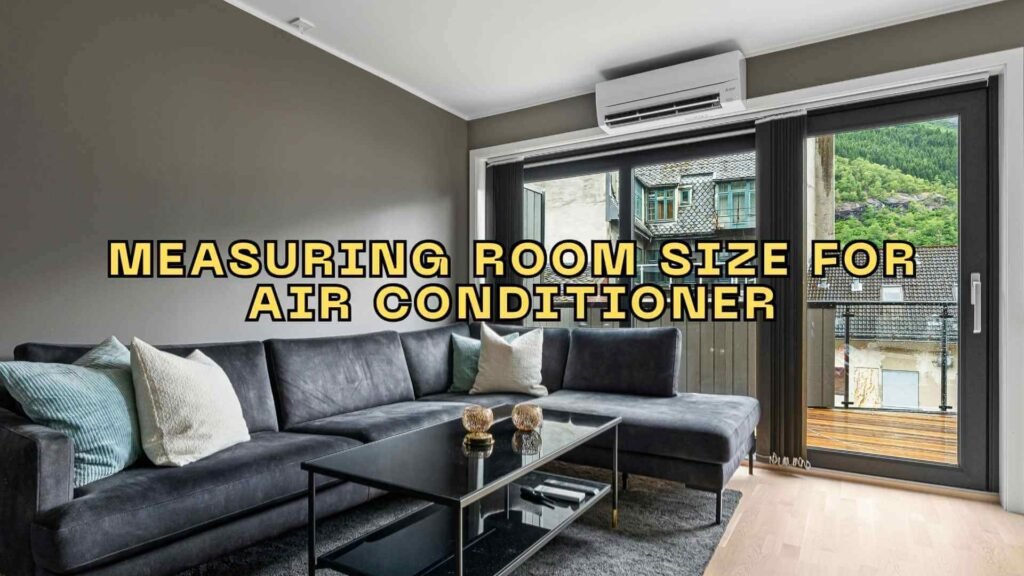
Measuring Room Size in Meters (or Feet)
Measure Length and Width
- Use a tape measure to determine the length and width of the room in meters.
- Multiply them to get the area in square meters (m²). Example: A room that is 4 m long and 3 m wide → 4 × 3 = 12 m².
Converting Square Meters to Square Feet (if needed)
Because most AC sizing guidelines in the U.S. use square feet, you can convert using:
- 1 square meter ≈ 10.764 square feet.
- So, 12 m² × 10.764 = ~129 sq ft.
Once you have the area in square feet, you can use standard BTU-based rules to size your AC unit.
Estimating Cooling Capacity: BTUs and Sizing Rules
What is BTU and Why It Matters
- BTU stands for British Thermal Unit — a standard unit measuring the amount of heat energy removed per hour by an air conditioner.
- Air conditioners are rated by BTUs (or tons, where 1 ton = 12,000 BTU/hour).
Common Rule-of-Thumb: 20 BTU per Square Foot
- In the U.S., a commonly recommended baseline is 20 BTU per square foot of living space.
- For example, a 300 sq ft room would need about 6,000 BTUs.
Sample Room‑Size to BTU Guide
Here’s a simple chart many HVAC experts reference:
| Room Size (sq ft) | Suggested AC Capacity (BTU/hr) |
|---|---|
| 100–150 sq ft | 5,000 – 6,000 BTU |
| 150–250 sq ft | ~6,000 – 7,000 BTU |
| 250–300 sq ft | ~7,000 BTU |
| 300–350 sq ft | ~8,000 BTU |
| 350–400 sq ft | ~9,000 BTU |
| 400–450 sq ft | ~10,000 BTU |
| 450–550 sq ft | ~12,000 BTU |
| 550–700 sq ft | ~14,000 BTU |
| 700–1,000 sq ft | ~18,000 BTU |
| … and so on. | … |
This gives you a rough ballpark for what size AC you need depending on your room’s footprint.
Adjustments: Why You May Need More (or Less) Cooling Power
Relying solely on square footage can sometimes under- or overstate your cooling needs. Several common factors influence the required BTU:
Additional Factors to Consider
- Ceiling height: Rooms with higher than standard ceilings hold more air — so more cooling capacity is needed.
- Insulation quality: Poor insulation — old windows, thin walls — means more heat enters, so you may need a more powerful AC.
- Sunlight exposure / windows: A room that gets direct sun, or has many windows, will heat up more. That often means adding ~10% extra BTUs.
- Occupancy: If more than two people regularly use the room, some guidelines suggest adding ~600 BTUs for each additional person.
- Room use (kitchen, heat‑generating equipment, etc.): Kitchens or rooms with equipment that generate heat may require a higher BTU unit.
Example: Adjusted BTU Calculation
Suppose you have a 12 m² room (≈129 sq ft) facing west (lots of sun), used as a small home office with two computers.
- Base estimate (129 sq ft × 20 BTU) = ~2,580 BTUs → round up to a small 5,000 BTU unit (standard smallest size).
- Because of sun and electronics heat: add ~10% → ~5,500 BTU.
- For comfort margin: choose next standard capacity (e.g., 6,000 BTU).
Why Using Meters (m²) Makes Sense for Some Users — And How to Use It
Using Metric System (Square Meters → BTU)
- Many worldwide guides convert room size in square meters directly into required BTUs. A common rule from metric‑based calculators is about 400 BTU per m² (for moderately shaded rooms).
- For a sunny room, some calculators increase this to ~520 BTU per m².
Thus, for a 12 m² room:
- Base: 12 × 400 = 4,800 BTU
- If sunny: 12 × 520 = ~6,240 BTU
This aligns reasonably well with the 20 BTU per sq ft rule when converted — and makes it easier if you’re measuring in metric.
Common Mistakes to Avoid When Sizing Your AC
- Using physical size (unit dimensions) as “size” — AC “size” refers to cooling capacity (BTU/Tons), not the physical dimensions of the unit.
- Oversizing “just to be safe” — Oversized AC units cool fast, but cycle on/off frequently, leading to poor humidity control and higher energy consumption.
- Undersizing to save money — Undersized units struggle, run constantly, wear out faster, and may still fail to deliver comfort.
- Ignoring room-specific conditions — A “one-size-fits-all” rule often fails if you don’t consider ceiling height, insulation, sunlight, windows, occupancy, and room usage.
Other Useful Terminology & Conversions
- Tonnage — Many AC units are also listed by “tons,” which in HVAC speak is a measure of cooling capacity. 1 ton = 12,000 BTU/hr.
- SEER / EER Ratings — In the U.S., many air conditioners carry a SEER (Seasonal Energy Efficiency Ratio) rating. Higher SEER means better efficiency — important when you want to save on power bills and get long-term value.
- Load Calculation vs. Rule-of-Thumb — For precise needs (especially whole-home HVAC, complex layouts, or large spaces), professionals perform a “load calculation” (e.g., Manual J), which is more accurate than basic rules.
Frequently Asked Questions (FAQ)
Can I size an AC unit purely based on room square meters without converting to square feet?
Yes, many metric-based guides simply use square meters — often recommending around 400 BTU per m² (adjusting for sun, insulation, etc.).
What happens if I choose an AC unit that’s too large for the room?
It will cool the air quickly but may cycle on/off frequently, waste energy, and won’t dehumidify effectively — leading to a cold but clammy environment.
What if the room has high ceilings or many windows?
You’ll likely need to increase the BTUs — because more air volume and sunlight leads to more heat gain. Many experts recommend increasing capacity or doing a more precise load calculation.
Does the number of people in the room matter for AC sizing?
Yes. For rooms with more than two regular occupants, some guidelines suggest adding ~600 BTU per extra person.
What about kitchens or rooms with appliances that produce heat?
Heat-generating appliances or kitchen cooking adds to the cooling load — you may need to add extra BTUs (sometimes around 4,000 BTU or more) to compensate.
Is the “20 BTU per square foot” rule always accurate?
No — it’s a guideline. For precise sizing (especially for whole-house systems, high ceilings, unusual layouts), a professional load calculation (e.g., Manual J) is recommended.
Why do some calculators recommend 400 BTU per m² instead of converting to square feet?
Because 400 BTU/m² roughly corresponds to ~20–25 BTU per square foot when converted — and it’s a simpler metric for those measuring in meters.
Summary
Sizing an air conditioner correctly is as much about calculation as it is about common sense: measure your room carefully (in meters or feet), convert to area, then use a rule-of-thumb (like 20 BTU per square foot or 400 BTU per square meter) as a baseline. From there, adjust upward based on factors like ceiling height, insulation quality, sunlight, occupancy and room usage.
While the rule-of-thumb works well for many typical rooms, remember that unusual layouts or demanding conditions may require a professional load calculation for accurate sizing. Proper sizing ensures efficient cooling, energy savings, and a comfortable, healthy indoor environment.